Monday, 9 June 2025

Subject File PARENTS and CHILDREN

What is parenting?

Parenting involves the process of raising children and providing them with protection, care, and guidance to ensure their healthy development into adulthood. It encompasses a wide range of activities, from ensuring their physical and emotional well-being to preparing them for social and academic success. 

Key aspects of parenting include:

Nurturing and Care
Providing love, emotional support, and physical care. 

Setting Boundaries and Rules: 
Establishing clear expectations and consequences for behavior. 

Guiding and Teaching
Helping children learn, develop skills, and understand the world around them. 

Promoting Social Skills 
Teaching children how to interact with others and navigate social situations. 

Ensuring Safety and Health
Protecting children from harm and promoting their overall well-being. 

Preparing for the Future
Equipping children with the skills and knowledge they need to thrive as adults. 


Ex. 1: Learn more about a father-son relationship. Complete the exercises on the website and listen to the audio. 


Tuesday, 3 June 2025

Subject File FAMILIES and FAMILY LIFE


The British Royal Family at Balmoral Castle, Scotland, 1960

Family - then and now

Family is vital to human society as it is the foundational unit for socialization, emotional support, and the transmission of values. It provides a sense of belonging, love, and security, which are crucial for individual development and well-being. 

Over history, however, the family has seen profound changes, not only in composition but also in the way family members relate to each other.

Sunday, 11 May 2025

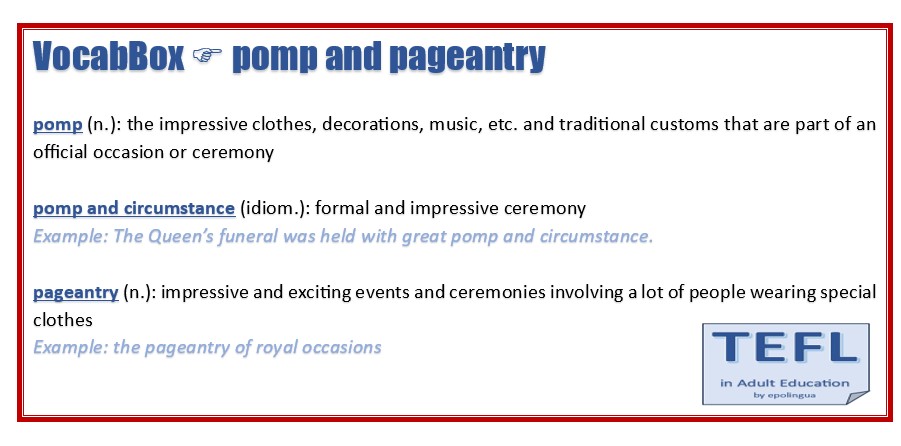
Country File UNITED KINGDOM: Pomp and Pageantry - the British Way of Celebrating Important National Milestones

British pomp and pageantry refer to the grand, ceremonial traditions that showcase the country's rich history and monarchy. 


These events are often marked by elaborate displays, military processions, and regal symbolism. Some of the most famous examples include coronations, Trooping the Colour, and state funerals. These traditions serve to reinforce national identity, continuity, and the prestige of the monarchy. They are deeply rooted in history and continue to captivate audiences worldwide.

Tuesday, 15 April 2025

SPOTLIGHT on ENGLISH # 5 _ English around the world - a global language

Why is English often talked about as a global language or lingua franca?

Approximately 1.53 billion people worldwide speak English, either as a native language or as a second or foreign language. This includes about 400 million native speakers. English is the most widely spoken language globally, even though Mandarin Chinese has more native speakers. 

This dominance is down to historical developments:

  • The British Empire spread English to many parts of the world during colonial times.
  • In the 20th century, the rise of the United States as a global superpower further cemented English as a key international language. Today, its role in globalization and international communication has made it even more essential.


Sunday, 6 April 2025

SPOTLIGHT on ENGLISH # 7 _ A History of English as a Global Language

A History of the English language


Ex. 1: Watch the presentation on youtube.

https://www.youtube.com/watch?v=eU9pshEkwVE


Ex. 2: Match the word groups to their origins.


Origins

No.

Word groups

1

Latin (Roman Empire, christianization)


potato, zeitgeist, tortilla, rucksack, tomato, schadenfreude, angst, kindergarten,

2

Celtic languages (pre-Roman British population)


castle, parliament, army, peasant, servant, baptism, duke, court

3

Germanic languages (invasion of the Angles, Saxons, and Frisians)


whisky, trousers, dad, clan

4

Old Norse (Scandinavian Viking settlements)


priest, mass, church, wall, military, wine, belt, monk, arena, angel, altar, bishop, pope, nun,

5

Norman Invasion and Conquest (1066 Battle of Hastings)


skull, husband, skin, window, sky, get, skirt, knife, egg, ill, skill, gate, mistake

6

Loan words from other languages around the world


kangaroo, boomerang, apartheid, pajamas, shampoo, bungalow, turban

7

British Empire/colonization: words coming in from former colonies


water, son, daughter, earth, mouth, brother, nose, child, drink, food, eat, sun, moon, wood, field, house, home, family, eyes


KEY Ex. 2: No. -> 6 – 5 – 2 – 1 – 4 – 7 – 3 

SPOTLIGHT on ENGLISH # 6 _ Geographies of English Around the World

Languages in Europe

Out of the 142 language families in the world, the Indo-European language family is the largest, comprising over 400 languages and dialects spoken by over three million people and with 46 % of the world population having a native language in this family. It dominates in Europe and large parts of central, southern, and eastern Asia.


The Indo-European language family can be divided into several branches, some of which are prevalent in Europe. These include:

  • Germanic languages, spoken by around 515 native speakers (English, German, Dutch, Afrikaans, etc.)
  • Romance languages, spoken by more than 900 million native speakers (French, Italian, Spanish, Portuguese, etc.) and descended from Latin, the language spoken in the Roman Empire
  • Slavic languages, spoken by more than 400 million people (Russian, Polish, Czech, Croatian, etc.)
  • Celtic languages, spoken by around 515 million people who are native and non-native speakers (Irish, Welsh, Scottish Gaelic, etc.)


Ex. 1: Study the info-graphic above and decide on the languages spoken in the following European regions:

  • Scandinavia and Northern European countries
  • British Isles and Western Europe
  • Central and Central Eastern Europe
  • Southeastern Europe
  • D-A-CH-L countries (Germany, Austria, Switzerland, Liechtenstein)
  • Benelux countries (Belgium, Netherlands, Luxembourg) 
  • Southern Europe and the Mediterranean Region
  • Eastern Europe
  • Baltic States (Latvia, Estonia, Lithuania)

Saturday, 22 March 2025

Culture File UK: Afternoon Tea - A Very British Tradition

Tea remains one of the most popular beverages in the British Isles. Only introduced in the 17th century, it has since become the nation's staple. 


It is not only a hot drink, taken with milk and sugar, or pure; it is a tradition, a philosophy, a lifestyle. As a matter of fact, coffee has become well-loved over recent decades; even so, tea remains at the centre of everyday life in the UK.

Country File UNITED KINGDOM: Guy Fawkes' Night _ Bonfire Night_5 November

Guy Fawkes Night , also widely known as Bonfire Night or Fireworks Night , is an annual British commemoration held on 5 November.  The Lewe...