In the weeks leading up to Christmas, people decorate their homes with Christmas trees, fairy lights, tinsel, and ornaments, and they place garlands on mantelpieces and windowsills.
 |
| A Christmas garland draped around the mantelpiece of a fireplace |
Door wreaths are particularly common, and preparing them is a source of anticipation and excitement for many people. Traditional materials used for a wreath include plants such as holly and ivy. Together with mistletoe, these plants are central to the mythology surrounding Christmas and the Winter Solstice, when the light returns after the longest night of the year.
Listen to the carol of the holly and the ivy:
King's College Choir, Cambridge, 2008: the Holly and the Ivy
In ancient times, people's survival was closely connected to light and warmth and the return of spring after a long and cold winter. Bringing these evergreen plants into their homes as a symbol of the vegetation at the longest and darkest moment of the season was symbolic of their dependence on nature.
 |
| Christmas door wreath with holly (red berries) and ivy (green leaves) |
Find out more on how to make a Christmas wreath:
Country Living UK: How to make a foraged Christmas wreath and garlands
Christmas Eve (24 December) in the UK is a time for preparations and anticipations. It is usually the last opportunity to buy gifts or get food. Many people opt to attend a church service such as Midnight Mass; others enjoy a cozy evening of relaxing and winding down with the family, singing carols, listening to festive music, watching a Christmas movie, or preparing the Christmas feast, wrapping gifts, or finalizing decorations.
Many British children believe in Santa Claus, also known as Father Christmas. The magic of Santa Claus is a big part of the Christmas season for kids in the UK. They eagerly await his visit on Christmas Eve, believing he travels from the North Pole on a sleigh pulled by reindeer to deliver gifts to all the good boys and girls.
 |
| Father Christmas aka Santa Claus on the sleigh pulled by reindeer |
Find out more about Father Christmas
Listen to a very popular Christmas song:
The children leave stockings by the fireplace or at the foot of their bed, hoping they'll be filled with gifts in the morning. They usually leave out a snack for Santa (often mince pies and a glass of milk or sherry) and a carrot for the reindeer.
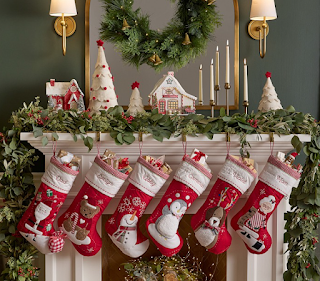 |
| Christmas Stockings by the fireplace |
On Christmas Day (25 December), a public or bank holiday, the main celebrations take place. The day typically begins with opening the presents that have been placed under the Christmas tree. Family and friends have been invited to enjoy a traditional Christmas dinner with a range of traditional dishes.
The main course comprises a roast turkey stuffed with breadcrumbs, herbs and onions, and served with roast potatoes, a variety of vegetables such as Brussels sprouts, carrots, parsnips, and red cabbage, and accompaniments such as cranberry sauce, gravy made from the juices of the roasted meat or Yorkshire Puddings.
 |
| Roast turkey with vegetables and roast potatoes |
As a dessert, people like to enjoy a Christmas Pudding made of fruits, flamed with brandy and served with custard. They also have mince pies filled with a mixture of dried fruits, spices, and brandy, or they enjoy a trifle, a layered dessert consisting of sponge cake, custard, fruit jelly, and whipped cream.
 |
| Christmas Pudding |
Typical drinks enjoyed with a Christmas meal are mulled wine with spices or eggnog, a creamy, sweet drink made with milk, cream, sugar, and eggs, often spiked with rum or brandy.
 |
| Eggnog, a traditional Christmas beverage |
Christmas crackers are an important part of the British Christmas tradition. Depending on the size of the Party crackers, the crackers usually contain a paper crown, some jokes, games or puzzles and a small gift. English Christmas crackers are especially popular with children. But also for adults this British Christmas tradition is a funny highlight - whether at the Christmas party, as a gift for friends and colleagues or with the family at Christmas.
 |
| Christmas crackers |
At 3 PM on Christmas day, many people tune in to watch the King's Christmas Speech, a cherished tradition in Britain, dating back to 1932, when King George V, the current monarch's grandfather, delivered the first broadcast. Each year, the speech reflects on the past year's events, offers hope and encouragement, and emphasized the importance of family, community, and togetherness.
 |
| King Charles III at Buckingham Palace |
Christmas Day usually ends in a cozy and relaxed manner. People sit down to enjoy some activities such as board games, card games, or charades, or they settle down to watch Christmas specials, films, or the traditional pantomime on TV. After a long day, this is the time to relax with some mulled wine or hot chocolate for the children, before their bedtime.
 |
| Dick Whittington and his cat (Pantomime, Hackney, 2024) |
Boxing Day (26 December) is a public holiday or bank holiday in the UK. It is known for its sales, and many people head to the stores or shop online for post-Christmas bargains. It is a big day for sports when football matches or horse racing events take place, and attending these events or watching them is a popular post-Christmas pastime. Often, the day is spent visiting friends and relatives, or people take the opportunity to do some outdoor activities such as a relaxing walk or a visit to the beach, or they just stay at home and unwind from the Christmas celebrations. Traditionally, Boxing Day was a day for giving to the less fortunate. Some people still honor this by donating to a charity or volunteering their time.
London Evening Standard: Why is Boxing Day called Boxing Day?


