Tuesday, 3 June 2025

Subject File FAMILIES and FAMILY LIFE


The British Royal Family at Balmoral Castle, Scotland, 1960

Family - then and now

Family is vital to human society as it is the foundational unit for socialization, emotional support, and the transmission of values. It provides a sense of belonging, love, and security, which are crucial for individual development and well-being. 

Over history, however, the family has seen profound changes, not only in composition but also in the way family members relate to each other.

Sunday, 11 May 2025

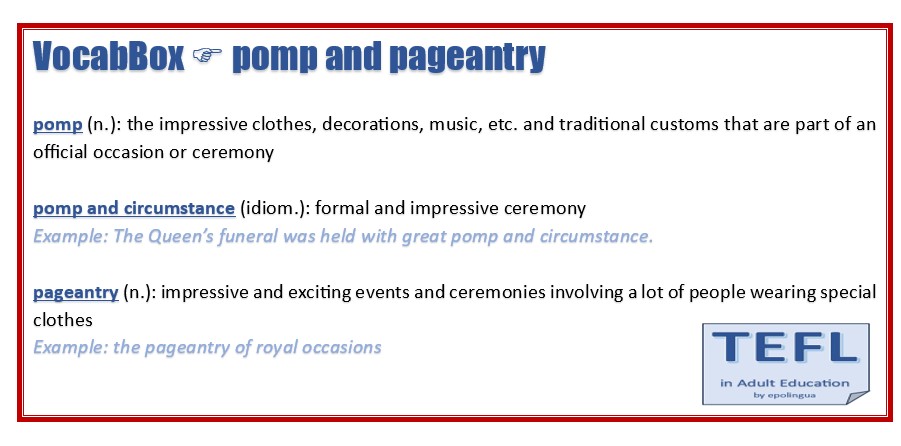
Country File UNITED KINGDOM: Pomp and Pageantry - the British Way of Celebrating Important National Milestones

British pomp and pageantry refer to the grand, ceremonial traditions that showcase the country's rich history and monarchy. 


These events are often marked by elaborate displays, military processions, and regal symbolism. Some of the most famous examples include coronations, Trooping the Colour, and state funerals. These traditions serve to reinforce national identity, continuity, and the prestige of the monarchy. They are deeply rooted in history and continue to captivate audiences worldwide.

Tuesday, 15 April 2025

SPOTLIGHT on ENGLISH # 5 _ English around the world - a global language

Why is English often talked about as a global language or lingua franca?

Approximately 1.53 billion people worldwide speak English, either as a native language or as a second or foreign language. This includes about 400 million native speakers. English is the most widely spoken language globally, even though Mandarin Chinese has more native speakers. 

This dominance is down to historical developments:

  • The British Empire spread English to many parts of the world during colonial times.
  • In the 20th century, the rise of the United States as a global superpower further cemented English as a key international language. Today, its role in globalization and international communication has made it even more essential.


Sunday, 6 April 2025

SPOTLIGHT on ENGLISH # 7 _ A History of English as a Global Language

A History of the English language


Ex. 1: Watch the presentation on youtube.

https://www.youtube.com/watch?v=eU9pshEkwVE


Ex. 2: Match the word groups to their origins.


Origins

No.

Word groups

1

Latin (Roman Empire, christianization)


potato, zeitgeist, tortilla, rucksack, tomato, schadenfreude, angst, kindergarten,

2

Celtic languages (pre-Roman British population)


castle, parliament, army, peasant, servant, baptism, duke, court

3

Germanic languages (invasion of the Angles, Saxons, and Frisians)


whisky, trousers, dad, clan

4

Old Norse (Scandinavian Viking settlements)


priest, mass, church, wall, military, wine, belt, monk, arena, angel, altar, bishop, pope, nun,

5

Norman Invasion and Conquest (1066 Battle of Hastings)


skull, husband, skin, window, sky, get, skirt, knife, egg, ill, skill, gate, mistake

6

Loan words from other languages around the world


kangaroo, boomerang, apartheid, pajamas, shampoo, bungalow, turban

7

British Empire/colonization: words coming in from former colonies


water, son, daughter, earth, mouth, brother, nose, child, drink, food, eat, sun, moon, wood, field, house, home, family, eyes


KEY Ex. 2: No. -> 6 – 5 – 2 – 1 – 4 – 7 – 3 

SPOTLIGHT on ENGLISH # 6 _ Geographies of English Around the World

Languages in Europe

Out of the 142 language families in the world, the Indo-European language family is the largest, comprising over 400 languages and dialects spoken by over three million people and with 46 % of the world population having a native language in this family. It dominates in Europe and large parts of central, southern, and eastern Asia.


The Indo-European language family can be divided into several branches, some of which are prevalent in Europe. These include:

  • Germanic languages, spoken by around 515 native speakers (English, German, Dutch, Afrikaans, etc.)
  • Romance languages, spoken by more than 900 million native speakers (French, Italian, Spanish, Portuguese, etc.) and descended from Latin, the language spoken in the Roman Empire
  • Slavic languages, spoken by more than 400 million people (Russian, Polish, Czech, Croatian, etc.)
  • Celtic languages, spoken by around 515 million people who are native and non-native speakers (Irish, Welsh, Scottish Gaelic, etc.)


Ex. 1: Study the info-graphic above and decide on the languages spoken in the following European regions:

  • Scandinavia and Northern European countries
  • British Isles and Western Europe
  • Central and Central Eastern Europe
  • Southeastern Europe
  • D-A-CH-L countries (Germany, Austria, Switzerland, Liechtenstein)
  • Benelux countries (Belgium, Netherlands, Luxembourg) 
  • Southern Europe and the Mediterranean Region
  • Eastern Europe
  • Baltic States (Latvia, Estonia, Lithuania)

Saturday, 22 March 2025

Culture File UK: Afternoon Tea - A Very British Tradition

Tea remains one of the most popular beverages in the British Isles. Only introduced in the 17th century, it has since become the nation's staple. 


It is not only a hot drink, taken with milk and sugar, or pure; it is a tradition, a philosophy, a lifestyle. As a matter of fact, coffee has become well-loved over recent decades; even so, tea remains at the centre of everyday life in the UK.

Saturday, 18 January 2025

Culture File U. S. A. - The Inauguration of a New President

Donald J. Trump's Inauguration as the 47th President of the United States

On Monday, 20 January 2025, the United States will witness Donald J. Trump's second inauguration, this time as the 47th POTUS. 

The inauguration is a formal event to mark the beginning of a new presidency, and it involves a ceremonial induction into office. It is usually held around two and a half months after the presidential elections, and its core component is the president-elect taking the oath of office, which is mandated by the United States Constitution. 

Most inaugurations have been held in Washington D. C., more specifically at the west front of the Capitol, the seat of Congress as the legislative branch of the U. S. government, facing the National Mall with its iconic Washington Monument and the distant Lincoln Memorial.


Inauguration of President Barack H. Obama, 2013, https://obamawhitehouse.archives.gov/photos-and-video/photo/2013/01/panoramic-view-west-front-us-capitol


Inaugurations are social events as much as political ones, often with hundreds of thousands of spectators descending onto Washington and parades as well as other social gatherings. Often, the event is used by protesters to express their opposition to or concern about the president-elect and their politics. However, they are also an opportunity to unite all state representatives, regardless of political affiliation, as well as to invite foreign dignitaries. 

Donald J. Trump taking the oath of office as the 45th President of the United States, Jan 20, 2017, https://www.nbcnews.com/podcast/inside-impeachment/transcript-president-s-oath-n1111861

The vice-president-elect first pledges allegiance to the Constitution of the United States, and after that the president-elect recites the oath: 

"I do solemnly swear (or affirm) that I will faithfully execute the Office of President of the United States, and will to the best of my ability, preserve, protect and defend the Constitution of the United States."


Besides the oath of office, other ceremonial elements are also central to the proceedings, among them the inaugural address, which is the speech the newly inaugurated presidents deliver and in which they set out their objectives for their presidency and outline the vision they build their presidency on. Some speeches have entered cultural memory owing to the orator's eloquence and their memorable statements. Among them is John F. Kennedy's "And so my fellow Americans: ask not what your country can do for you - ask what you can do for your country."


Due to projected low temperatures and wind gusts, caused by a polar vortex, this year's inauguration ceremony has been moved into the U. S. Capitol and will be held in its Rotunda. 


CNN: Trump's inauguration to be moved indoors


Another important element of the inaugural events is the presidential parade which usually takes place on Pennsylvania Avenue in the heart Washington D. C. Again, due to the weather conditions, it will be relocated to the Capitol One Arena.

President Ronald Reagan and his wife Nancy during the Inaugural Parade, 1981


After that, the newly inaugurated president heads to the White House, the official presidential residence for the 4-year-term. The Oval Office, the official workplace of the president, will be the place for another ceremony. 

President George W. Bush in the Oval Office of the White House, 2003; https://www.georgewbushlibrary.gov/bush-family/george-w-bush


The day of the inauguration draws to a close with a series of inaugural balls which cater to a diverse audience: military service members, supporters, and the big donors whose financial contributions have made all of this possible, in the first place. 

Bill and Hillary Clinton at the Inaugural Ball, 1993

Country File UNITED KINGDOM: Guy Fawkes' Night _ Bonfire Night_5 November

Guy Fawkes Night , also widely known as Bonfire Night or Fireworks Night , is an annual British commemoration held on 5 November.  The Lewe...